Essential Tips for Choosing the Right Board to Board Connector?
Choosing the right board to board connector is crucial for your projects. A well-selected connector can enhance performance and reliability. However, the process can be confusing.
Many factors impact your choice. For instance, consider the size, number of pins, and data transfer rates. A wrong decision may lead to complications and failures in your system. It is essential to gather detailed specifications before making a choice.
Furthermore, understanding the application is vital. Some connectors work best in specific environments. Be mindful of durability and thermal conditions. Not all connectors suit every need. Thus, taking time to evaluate your options is necessary for success.
Understanding the Role of Board to Board Connectors in Electronics
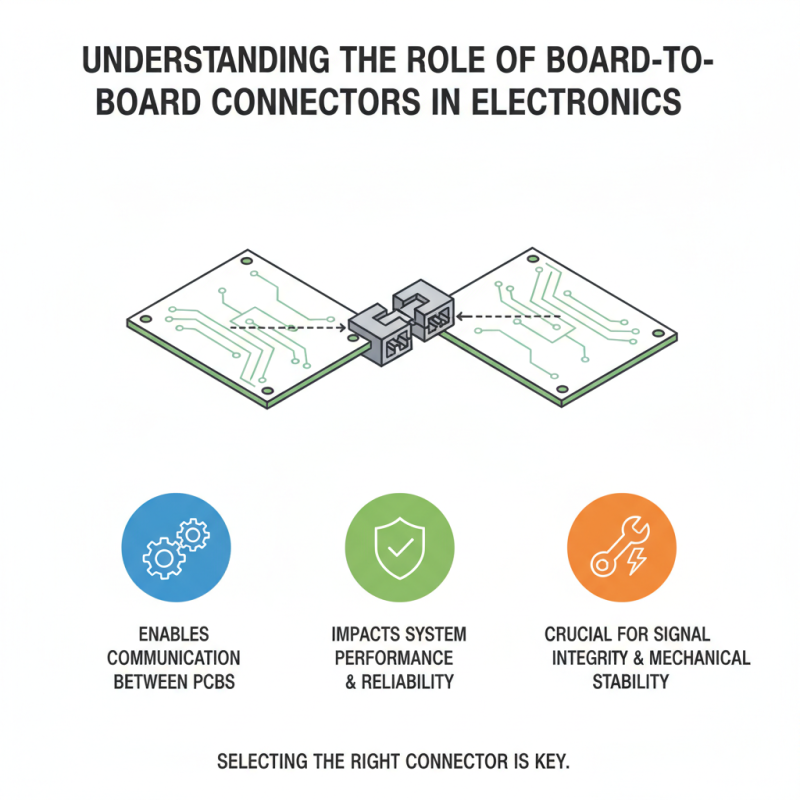
Board to board connectors play a vital role in electronic devices. They allow communication between two printed circuit boards (PCBs). This connection affects the performance and reliability of the entire system. Selecting the right connector is crucial to ensure signal integrity and mechanical stability.
When choosing connectors, consider the size and pitch. A compact design can save space, but it might limit performance. Connectors with larger pitches often handle higher currents. Additionally, the number of pins influences the functionality of the connection. It’s key to match the pin count to your specific application needs.
Material choice is another aspect to ponder. Metal connectors are durable but can add weight. Plastic connectors are lighter but may not withstand harsh environments. Intentional imperfections in designs can lead to reflections in signal quality. Always evaluate how these factors can impact your project’s success.
Key Specifications to Consider When Selecting Board to Board Connectors
When selecting board to board connectors, key specifications play a critical role. The pin pitch is one vital aspect to consider. It refers to the distance between pins. A smaller pitch often enables a more compact design. However, it can complicate soldering and assembly. Finding the right balance is essential.
Next, consider the number of contacts. More contacts provide greater functionality but also increase complexity. Ensure the connector meets the power and signal requirements of your application. Additionally, the operating environment must be assessed. Temperature fluctuations, humidity, and vibration levels can impact performance.
Material selection is another area that deserves attention. The choice between different metals can affect conductivity and durability. Some metals may corrode in certain environments. This can lead to connectivity issues later on. Lastly, take into account manufacturing processes like automated assembly. Complex designs can cause challenges during production. Reflect on these details carefully.
Types of Board to Board Connectors and Their Applications
When selecting a board-to-board connector, understanding the types can significantly impact your project. Compact connectors are ideal for space-constrained applications. They often feature low-profile designs, making them suitable for portable devices. On the other hand, high-current connectors can handle greater power loads. These are crucial for industrial applications requiring robust performance.
Another type to consider is the stacking connector. This type allows for vertical connections between boards, which maximizes space and improves layout efficiency. Their applications range from consumer electronics to medical devices. Additionally, rugged connectors are designed for harsh environments. They are built to withstand extreme temperatures and humidity. However, finding the right balance between durability and size can be tricky.
It's important to pay attention to key specifications like pitch and pin count. A mismatch can lead to connectivity issues. Also, ensure the connector can support the necessary data transfer speeds. Not all connectors will perform equally well under stress. Therefore, considering the specific application environment is essential. This research may sound tedious, but cutting corners here could lead to larger problems down the road. Each type serves a unique purpose, so careful selection is key to project success.
Essential Tips for Choosing the Right Board to Board Connector - Types of Board to Board Connectors and Their Applications
| Connector Type |
Pitch Size |
Number of Pins |
Current Rating (A) |
Applications |
| Vertical Connector |
2.54 mm |
10 |
5 |
Consumer Electronics |
| Right Angle Connector |
1.27 mm |
16 |
3 |
Industrial Equipment |
| Stacked Connector |
0.80 mm |
30 |
1.5 |
Telecommunications |
| Micro Connector |
0.50 mm |
20 |
2 |
Medical Devices |
| High-Speed Connector |
1.00 mm |
40 |
2.5 |
Data Communication |
Best Practices for Installing Board to Board Connectors
Installing board to board connectors requires precision. Proper alignment is crucial. Misalignment can lead to connection issues. Users often underestimate this aspect. Take the time to ensure everything lines up perfectly before securing the connectors.
Cleaning the surfaces before installation is equally important. Dust or debris can compromise connections. Use a lint-free cloth and isopropyl alcohol to clean the boards. It's a simple step, but many overlook it. This oversight can lead to frustrating performance problems down the line.
Additionally, pay attention to the right amount of force when securing the connectors. Too little force might result in a loose connection. Too much can damage the pins or connectors. It's often a trial-and-error process. Testing connections after installation can save time and headaches later. Be prepared to make adjustments as needed.
Essential Tips for Choosing the Right Board to Board Connector
Evaluating Reliability and Performance of Board to Board Connectors
When evaluating the reliability of board to board connectors, consider the material quality. The connectors should have high-grade materials to withstand harsh conditions. Materials affect durability and performance. A lack of adequate testing can lead to failures in critical applications. Seek connectors with established standards for material performance.
Performance evaluation also requires attention to the connector design. Pin arrangement and spacing are crucial for stability. Mismatched pins can lead to intermittent connections or complete failure. Testing for insertion force and retention strength is essential. These tests reveal how well the connector will perform over time.
Another aspect to ponder is environmental resistance. Many connectors face various temperatures and humidity levels. It’s vital to gauge how materials react under such conditions. Consider whether the connector meets specific environmental ratings. This often reveals if it can endure its intended use. Keep all these factors in mind, as overlooking details can result in costly mistakes.

 Email
Email WeChat