What is High Speed BTB Technology and Its Advantages in Modern Networking?
High Speed BTB technology represents a significant advancement in modern networking. Leading industry expert Dr. Jane Smith stated, “High Speed BTB reshapes how we connect.” This innovation allows for faster data transfer and reduced latency in networks.
The integration of High Speed BTB can lead to improved performance in data centers and enterprise networks. It supports higher bandwidth operations, enhancing user experience. This technology challenges existing frameworks, pushing for designs that better accommodate increasing data traffic.
However, the transition to High Speed BTB isn’t without complications. Organizations must grapple with compatibility issues and infrastructure upgrades. Not all systems can seamlessly integrate this technology. Reflecting on these challenges highlights areas for improvement and adaptation in the industry.
Definition and Overview of High Speed BTB Technology
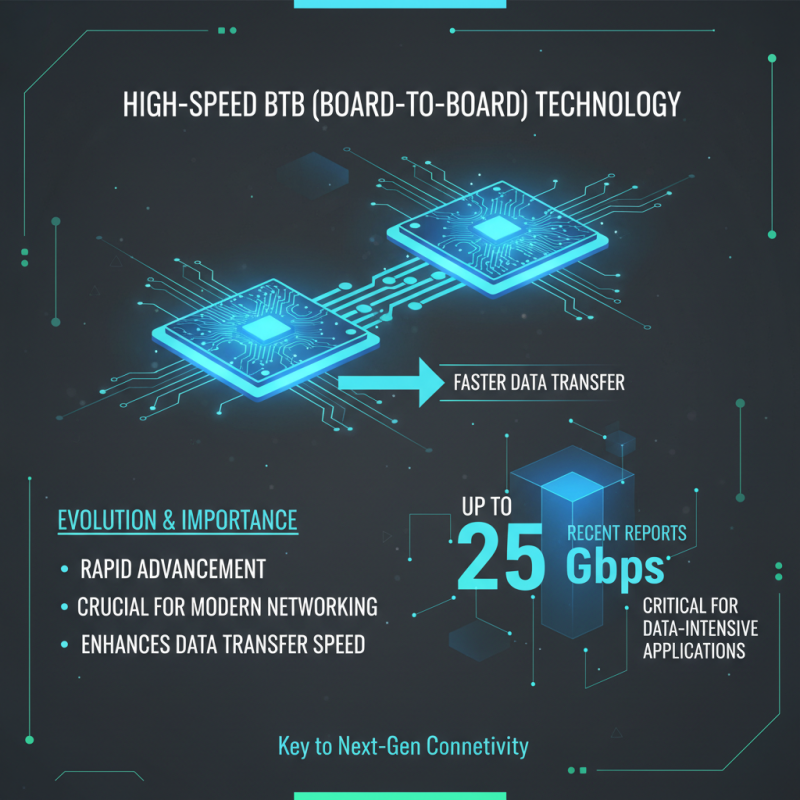
High Speed BTB (Board-to-Board) Technology is revolutionizing modern networking. This technology allows for rapid data transmission between printed circuit boards (PCBs). The key benefit is speed. High Speed BTB connections reduce latency in communication, making them ideal for data-intensive applications.
One interesting aspect is the design flexibility. High Speed BTB connectors come in various configurations. Designers are not limited to traditional layouts. This provides opportunities for innovation in device design. However, it can lead to challenges in compatibility. Engineers must ensure that components work seamlessly together.
Tips: Always consider the bandwidth requirements. Bandwidth is crucial for performance. Also, think about thermal management. High speeds can generate heat, affecting component lifespan. Balancing these factors is essential. Even minor oversights can lead to significant issues later on.
Advantages of High Speed BTB Technology for Data Transmission
High Speed BTB (Board-to-Board) technology is transforming data transmission in modern networking. It enables rapid data transfer between circuit boards, enhancing communication speeds in devices. Studies show that High Speed BTB connections can achieve data rates exceeding 25 Gbps, significantly reducing latency. This capability is crucial as demand for real-time data processing continues to rise.
One significant advantage of High Speed BTB technology is its space efficiency. Compact designs allow for high-density connections, which is vital in devices such as smartphones and data centers. According to industry reports, over 30% of energy used in data centers derives from inefficient data transmission methods. High Speed BTB can lower this usage, promoting more sustainable operations.
However, challenges remain. The complexity of implementing High Speed BTB technology can lead to increased costs. There is also a learning curve for engineers adapting to new designs. While benefits are clear, the transition might cause initial friction. Careful planning and training are essential for successful adoption. Balancing performance and costs requires reflection on current practices and infrastructure.
Comparison of High Speed BTB with Traditional Networking Solutions
High-speed back-to-back (BTB) technology marks a significant shift in networking solutions. Unlike traditional methods, which often rely on slower and more cumbersome connections, high-speed BTB offers direct, rapid communication between devices. This leads to better performance and reduced latency. Data transfers can happen seamlessly, enabling quicker responses in applications.
One notable contrast is the bandwidth capacity. Traditional solutions might struggle during peak usage times. High-speed BTB, on the other hand, can handle large volumes of data efficiently. This increase in throughput is crucial for businesses that depend on real-time data analysis. However, there are also challenges. Network setups may require careful planning and resources to implement BTB effectively.
Additionally, maintenance can become more complex with high-speed configuration. Ensuring compatibility with existing systems requires extra consideration. Failing to address these aspects could hinder performance. Furthermore, there's a learning curve for teams adapting to this technology. Thus, while high-speed BTB presents many advantages, analysis and strategic planning remain essential for overall success.
Applications of High Speed BTB Technology in Modern Industries
High-speed BTB (Board-to-Board) technology is transforming modern industries by enhancing data transfer rates. In sectors like data centers, the demand for rapid and reliable connections has skyrocketed. According to a recent industry report, the global data center market could reach $105 billion by 2025. This growth is driven by the need for faster and more efficient networks.
The applications of high-speed BTB technology are vast. In telecommunications, it allows seamless communication between devices. This technology minimizes latency, ensuring real-time data processing. A notable finding indicates a potential reduction in latency by up to 50% in networks using BTB solutions. Manufacturing sectors also leverage this technology for automation. Faster connections improve machine-to-machine communication, boosting overall productivity.
However, the rapid adoption of BTB technology isn't without its challenges. Implementation costs can be high, especially for smaller companies. Additionally, as networks become faster, companies need to ensure that their infrastructure can keep up. Reliability issues may also arise if systems are not properly configured. These considerations are crucial for businesses looking to benefit from high-speed BTB technology while maintaining efficient operations.
What is High Speed BTB Technology and Its Advantages in Modern Networking? - Applications of High Speed BTB Technology in Modern Industries
| Dimension |
Description |
| Data Transfer Rate |
High Speed BTB technology supports data transfer rates typically ranging from 25 Gbps to 400 Gbps. |
| Latency |
Reduces latency in data transmission, enhancing real-time communications and applications. |
| Power Efficiency |
Improves power efficiency, allowing for lower operational costs in data centers and network infrastructure. |
| Scalability |
Enables easy scalability of networks to accommodate growing bandwidth demands. |
| Applications |
Used in various industries such as telecommunications, data centers, and automotive industries for high-speed data processing. |
| Cost Effectiveness |
Provides a cost-effective solution for high-volume data transmission over short distances. |
| Flexibility |
Offers flexibility in deployment across various architectures and hardware configurations. |

 Email
Email WeChat